
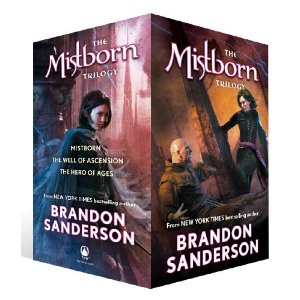
I’m an avid reader, and my favorite genre is fantasy. Most recently, I devoured the Mistborn trilogy (Mistborn, The Well of Ascension, The Hero of Ages) by Brandon Sanderson. I never would have picked them up if Sanderson hadn’t been chosen to finish Robert Jordan’s Wheel of Time series after the author’s untimely death to amyloidosis, but I couldn’t put the books down once I started.

There was a major problem, though. The books made me angry.
And after finishing the third novel Friday night and finding myself unable to fall asleep for two hours because of how much I hated the ending, it got me thinking about why it bothered me so much. These are things that writers really need to keep in mind. (With an actual book review at the end that many of you will choose to skip. And psst… that image is an Amazon affiliate link in case you’d like to buy the set and see what I’m talking about.)
You need to relate to your audience.
This is something that Brandon Sanderson got right. In fiction, relating to your audience is done by creating characters that your readers can become invested in. I was sucked in to the strange world of the Final Empire because I was so drawn to Vin, even though the setting was so completely foreign to me. (And as a fantasy reader, it takes a lot for a setting to just seem so odd.)
If you’re not writing fiction, this rule still applies. You have to give your readers a reason to care about what you’ve written, or else they’re just not going to bother with it. Writing to promote a product? A news story? Make sure people see why they should care about it in the first few lines. If they’re not feeling it, they’re not going to continue reading.
Once you know the rules, you can break them. But only in moderation.
I just broke one of the rules of writing up there with a sentence fragment. Sentence fragments may be grammatically incorrect, but they have a place in novels, blogs, etc. But if you start using them all the time, people are going to think you just don’t have a clue about sentence structure, and it may become distracting enough that they just give up trying to read.
Sanderson got this one wrong. Fantasy authors can get away with a lot, since they don’t have to create worlds with the same physical rules as our own. Readers have a pretty healthy suspension of disbelief, but there are still certain conventions that we expect to be followed. It’s great to try a revolutionary new way of doing things, but if you go too far off in left field, you’re going to lose people.
Make your point, but don’t be repetitive or beat people over the head with it.
In web copy, it’s easy to get this wrong. Sales copy can be overhyped, repeating the same things over and over in order to convince readers that they just can’t live without some new product. SEO writers try to cram the same tired keyword phrases into a 300-word article, making it appear unnatural and not intended for human eyes. You can use those keywords a few times, but remember the readers – and it’s far more user-friendly to use synonyms every once in a while.
There was one page in Mistborn where Vin, the female protagonist, was learning how to use the Final Empire’s version of magic… But I swear I read the word burned 12 times in just two or three paragraphs on a single page. There weren’t any synonyms because Sanderson used the term to explain how the magic worked. It was so frustratingly repetitive and hard to follow.
And then there was the whole theme of religion and faith in the book. Unfortunately, by the time I got to the end of the third book, I just didn’t want to hear about it anymore. It had been beaten into my skull for two books, and I’d had enough. (Wheel of Time readers may sympathize with me about the countless descriptions of Nynaeve tugging her braid, or the maddening politics surrounding Elayne’s claim to the Lion Throne of Andor over the last 12 books.)
There are red herrings, and there are big scarlet sharks with frickin’ laser beams on their heads.
No one likes a story that is too predictable. Readers like their surprises. But if they discover they can’t trust a single clue you’ve left for them because everything is some form of misdirection, that’s just uncool. There was one particular mystery I figured out without having a single clue given to me – and it was one of those things like when you watch a crime drama and try to pick the least likely suspect to be the offender. I was right about it, just because I had a hunch that I was intentionally being led astray. But I was wrong about everything else. And it’s very unsatisfying to learn that nothing has turned out the way you expected it to.
It took me a little while to figure out how this could apply to non-fiction writers. I think the main thing to remember is that – when you’re not writing an epic novel where readers have invested in 100k+ words for the long haul, say what you mean. Don’t keep people guessing too much, because if they never finish the piece, they’re going to come away with the wrong idea.
Be compelling.
Sanderson got this right. I am fully admitting that the end of all three books in the series made me incredibly angry, leaving me very unsatisfied. Maybe it’s still too soon to process my post-reading emotions, but I really did not like the trilogy.
And yet… I couldn’t stop reading it. I kept reading because I wanted to know what happened. I wanted to see if it really would turn out alright in the end. I wanted to Sanderson to prove me wrong, that I would finally be able to forgive him after all for putting me through such torture in the first two books.
But I can’t currently forgive him for that. I’m left unsatisfied by the plot resolution. I needed a good ending, and while some people may think they got it… I did not.
If you can write something so compelling that people can’t stop reading despite their dislike of the subject matter or the way things turn out… You’re a freaking great writer. But that doesn’t mean people will keep reading what you write, if you can’t eventually satisfy them. Even great writers can learn how to be better.
And that, my friends, it what Mistborn taught me about writing.
Spoiler alert.
If you just wanted the writing tips, you probably want to stop reading here. If you ever plan to read Brandon Sanderson’s Mistborn trilogy but haven’t gotten around to it yet, you definitely want to stop reading, because I will ruin the end of the series for you.
What I loved.
I loved Vin. She was flawed, but that’s what made her endearing. I loved Kelsier. I loved Elend, Breeze, Spook, and so many of the other supporting characters. They were all so well-developed, not just two-dimensional heroes or villains. I loved the relationship between Vin and the other characters, particularly Elend.
I loved the idea of Allomancy. It took me 75% of the first book to be accustomed enough to it that it was no longer tedious to read about, but I think the invention of a system of magic involving metal was brilliant.
And that’s where I get off the love train.
Religion.
Okay, Brandon Sanderson. I get it. The whole thing was about dogma. It wasn’t about the characters at all. But the characters were what I loved. I didn’t love Sazed’s 700-page-long emo crisis of faith. I could appreciate the parallels to real-world religion – the deification of the Survivor after his apparent resurrection, the manner of his death becoming a symbol for the Church of the Survivor. But the third book’s heavy religious content was just so unlike the first two books, it just felt wrong to me, like I’d been betrayed. (Oh, and by the way? I thought it was the “Hero of the Ages” until halfway through the last book. It just sounds weird the way it was actually written.)
Red herrings.
The whole freaking trilogy was one, long red herring. Alendi. The Lord Ruler. The Well of Ascension. The Deepness. Hell, Vin herself was the biggest freaking red herring of the whole thing. She’s on the cover of all three books, and she wasn’t the Hero of Ages? Are you kidding me? I read the series because of her. I became emotionally invested in her. Sure, she was deified for about 10 minutes at the end… but to make the culmination of the trilogy, the subject of the entire thing ended up being a secondary character who did nothing but sulk for the last 700 pages… NO. Just no. That is not a satisfying end. I felt sorry for Sazed when he lost Tindwyl, but I didn’t care about him the way I cared about the other characters. I wasn’t invested in him. And for him to become God? NO.
I felt cheated that I’d been misled the entire time. (Much like Vin must have felt when she realized Ruin had been manipulating her all along, but that’s another story.)
The one thing I did figure out? Who the kandra had replaced in The Well of Ascension. The whole time Vin was trying to figure out which member of the crew had been replaced, I was suspicious of the suddenly friendly wolfhound at her side. I was onto you, TenSoon!
Breaking the rules.
One of the testimonials at the front of the book mentions how Sanderson used so many archetypes and fantasy standards in such an unconventional manner, praising his genius at doing what’s never been done before. In my opinion, he crossed the line. He was too revolutionary.
Fine. He killed the male protagonist at the end of the first book. I guess that wasn’t so new… Galdalf, Obi-Wan Kenobi – the master sacrificing himself is an old standby. Killing other secondary characters the readers had grown attached to? Bold. Many authors have a hard time killing beloved characters. Repeatedly telling the readers that everything from the previous book was a lie? Uncool. Killing the main character who appeared on all three covers in the trilogy? Whoa there. Replacing her with a character who hadn’t been given much more attention than any of the other secondary characters? NO.
There’s thinking outside the box, and there’s totally disregarding the “natural” order of things. Readers have expectations, and we crave resolution. To resolve everything in a manner that goes against everything we’d been built up to hope for is a set-up for a big let-down.
I can’t get over Vin not being the Hero of Ages. Yeah, she was Preservation’s champion, and she defeated Ruin in the end… but she wasn’t the Hero of Ages. Up until the moment she died and her body fell into the ash, I had been expecting her to defeat Ruin and go on to re-create the world. Not Sazed. He didn’t earn that place in my heart.
Maybe I just get too emotionally involved in my books. I do tend to get depressed when I finish reading a particularly good book and I have to say goodbye to the characters. But this is really the first time that I was so involved in a book and it actually let me down. I’ve been disappointed by books before, but until now, they were books that I’d never really been able to get into in the first place.
I am very grateful that Robert Jordan left detailed notes about the end of the Wheel of Time series before his death. I can see that Brandon Sanderson has a lot of talent, but I do not trust him with developing his own plot.
Update (August 8, 2011): I got to meet Brandon Sanderson at last year’s New York Comic Con, and he was happy to discuss my dissatisfaction with the ending of the series as he autographed several of the books my husband and I brought with us. He’s heard the same complaint from other readers, and he explained the decisions he made. I told him I understood, but I still didn’t like the fact that Sazed was the Hero. He was cool with that. (He’s generally a cool guy, for the record! I do love fellow geeks.) I’m re-reading the series now in anticipation of The Alloy of Law
[…] This post was mentioned on Twitter by Christina Gleason. Christina Gleason said: What Mistborn Taught Me About Writing http://kl.am/Mistborn […]
I have to say that you took the book the wrong way. You should have started reading Brandon with his first novel Elantris which would have gotten you ready for Mistborn. And let me be very clear on this; Brandon would NEVER write The Wheel of Time like his other books. (See this and you’ll know why: http://brandonsanderson.com/blog/550/EUOLogy-Goodbye-Mr.-Jordan) Now first off, if you had began with Elantris you would know that having so little region in books 1&2 was the thing that felt wrong. Two go back and carefully read the chapter headings for the first book, particularly the things pertaining to the hero. Look at the heading for chapter 8, or really any chapter. The one were he references the stretched out ear lobs the hero is soused to have, which Sazed does and Vin does not. you’ll see that Brandon is quietly pointing at the hero the whole time and i have really meet people who had guessed that Sazed was the hero. (Also look at what Kwaan says as well.) And he does speend a lot of time in book 3 helping you learn to love Spook who will take on Eland’s place as people begin life anew. Also you may like to know Brandon will be making Mistborn into a trilogy of trilogies, though i don’t know if it’s going to take place thousands of years latter or during the funding of Spook’s new empire. Now also, put yourself in Sazed’s shoes. his emo stag was the right thing to do. And if he hadn’t had it he would have guessed out what was going on and prevented the death of Eland. (Though Vin does have to die so Sazed can take the powers.) Really if you re-read book three (which im doing now) you’ll see he gets close to the answer often but gets side tracked.
Sorry for all the typos above.
All that I can say to what you have written is, “wow…” You were left so angry, not because the books ended poorly or because you couldn’t guess where the story was heading, but because everything wasnt all happy dandy and perfect. The books were amazingly constructed. The plot line was so unpredictable that it awestruck me when it all came together, not because I wasn’t expecting it, but because how even though I didn’t expect it, it still fit together so well. You wanted everything to end perfect thats quite understandable if you are still reading childrens fantasy novels. Most of us however, Like novels that throw a curve ball that hits you right where you weren’t expecting it. I highly reccomend never reading George R.R. Martins A Song of Ice and Fire because I would not want you to blather about how it did things you weren’t expecting and probably made you cry. The books shocked you from your normal reads and made you think, “Wait! Things dont end perfect sometimes?” And if you could not follow that section with all the “burns” in it then I advise stepping down to some simpler authors, such as Dr. Seuss, but be careful because he can be quite unpredictable because you can never quite guess what words rhyme with “hop” or “fish.” Lastly about Nynaeve’s hair pulling in Wheel of Time, it’s her character. Its there because its how she was developed. It would be awkward if it didn’t mention it. It would lead me to assume that she was possibly taken over by a poorly trained Kandra. Do not tell the world that you were angry about a book because it wasn’t happy go lucky at the end or you’ll probably continue to get comments like this.
Wow, guys. Not everyone has to love every book. Did you miss the part where I said the writing was so brilliant I couldn’t put the books down? Also, any book that can arouse an intense emotion like anger over the ending…the writer gets credit for being able to get readers that emotionally invested.
I told Brandon Sanderson I hated the ending when I met him at the 2010 New York Comic Con. Said it to his face. And he didn’t have nearly the reaction that you – Avi and Garry – had. We had a nice discussion about how he’d planned it from the beginning, and I said I understood why he did it, but that didn’t mean I had to like it. 🙂 He was very cool, and he told us about the Mistborn short story/novella he’s working on…before he officially announced it. And that he’s going to write a second trilogy.
I’m still a Brandon Sanderson fan, but I still hate the way the Mistborn trilogy ended. And I’m entitled to my own opinion.
Christina,
I liked your article a lot. However, I felt satisfied with the ending, and I thought you may want to know why ( Please forgive the typos, if any).
I really liked Sazed from the beginning, for his rebelliousness and doing what he thought was right. He said his mind in the most polite way possible.
The biggest red herring possible? You are right. However, I was amazed, and not angry, at how he pulled this off without alerting me.
When Vin died, I felt bad; but then she was happy, and she seemed like someone who would be happy. Taking rest with Elend after working hard her whole life must be nice (for her).
I felt Elend’s death was unjustified emotionally, as he would want to care for his people. But then Sazed said Elend was happy… so I suppose it is okay.
I loved the ending. It is hard to explain why, but I felt it is time to start a new trilogy.
“Once you know the rules, you can break them. But only in moderation.”
I totally agree with you on this. Brandon did many things like –
Sam entered the room, and stood opposite Red. His face was tired; his braids we all over the face, the different rubber bands highlighting the variety of products available at the factory.
Sam fell down, dead.
While they were nice sometimes, it was cliche other times.
Moreover, he kept saying – Vin paused. Elend paused. (…)
That got irritating at some points.
Do you know why obsidian can(not) be pull(sh)ed? If you do, please share.
Thanks for reading!
First off, I wasn’t nearly as bugged as you seem to think I was. The only part that bugged me was what you said about Brandon messing with The Wheel of Time. I find the fact that you hate the end rather amusing. The reason I said what I did was even with saying that you respected him as an author, you were making it sound like he was some kind of monster, so I was pointing out to those who didn’t know that he isn’t. Also, there will be two more trilogies set in the world of Mistborn, not just one. And there will be guns. (Sazed says in one of the chapter headers that guns already existed, but the Lord Ruler suppressed them.) and Suman, obsidian is a rock, not a metal.
And one last thing; If you ever intend on reading his other works, Elantris’s ending as well as The Way of Kings’s aren’t as. . . surprising. Warbreaker’s might make you a little mad, but not nearly as much.
I found that I was completely content at the end of the third book. I haven’t ever felt that about another series, so it really surprised me when i found B.S had done it.
I thought that Vin and Elend having something together in the afterlife, where they could finally be away from all of the troubles that had previously plagued them, was about the best thing that B.S could do for them.
The fact that Vin wasn’t the Hero of Ages was pretty cool too. It’s kind of annoying to consistently read stories about a prophesied hero who beats the baddie. To find out that she wasn’t the hero everyone thought she was, was in my opinion a great plot twist.
I did think that Hero of Ages sounded a little funny though. I chose to just ignore how he’d written it and think of it as Hero of the Ages anyway.
Oh and, it’s The Hero of Ages for a reason. It’s like The Days of Doom and not The Days of the Doom (not from a story, I just made it up as an example.) Also, think of it this way; Brain Boru, a man who united Ireland in the past, is know as The Lion of Ireland. He saved Ireland from continued wars between clans and therefore he was the hero of Ireland, not the hero of the Ireland. It just doesn’t make sense that way. Also anther example; The Hero of Time, not The Hero of the Time. Get it? It’s not a hero to be remembered for ages, (which is what would make it The hero of the Ages) but the ages is what the hero saves, so it’s written The Hero of Ages. You see?
I, like you, came to Sanderson as a Wheel of Time fan. When I had read that most of Sanderson’s awards at that point had been from romance writing, I cringed to think that he would be carrying my most beloved characters to the slopes of Shayol Ghul for the Last Battle, so I felt that I had to read Mistborn just to figure out how I felt about the announcement.
I loved every page. Instead of feeling like my favorite series was going to be lost to some unknown, some hack brought in to stumble through the master’s work, my fears were completely obliterated. In fact, Sanderson became my favorite author after I finished reading Hero of Ages, replacing Robert Jordan.
Mistborn remains my favorite trilogy today. His work on Wheel of Time has been great, although I’d still rather have seen Robert Jordan finish it all. I enjoyed Elantris and Warbreaker, and I am trying very hard to be patient and await the next installment of The Stormlight Archive, which doesn’t even have a tentative release date yet because of A Memory of Light (which I also want, even more, actually).
Before I sound like a rabid fanboy convert, I feel it is my duty to state that I do not think Mistborn was perfect. I merely don’t share the same objections as you.
[…] series, but hate the ending. I wrote about this when I first finished the series, a post entitled 5 Things Mistborn Taught Me About Writing. (The first part of that post is completely spoiler-free, but the last part contains serious […]
Yes. I agree.
SPOILER *****
I think what shocked me so much about this book series was how many deaths there were. I started reading the Stormlight Archive by Brandon Sanderson first. HIs world and magic building skills completely won me over. After that I read the Rithmatist, the Reckoners series, the Librarians of Alcatraz, Elantris, Warbreaker… And lastly, I picked up the Mistborn series.
I just finished it two days ago, and it took me as a surprise because characters died and *stayed dead*
In all of his previous books I felt like he got into the habit of ripping my heart out with the brutal death’s of characters, only to bring them back later on. So, when I read the Mistborn books, I totally expected him to pull his typical stunts and bring the main characters who died back to life.
Boy was I wrong.
The world building and magic building in this world was as usual, the best thing I’ve ever seen. But the ending left me confused, and even a little sad.
The series was trash to put it simply. If the rants about religion and politics were removed the books would have only been 50 pages. The series dragged out endlessly with not really point of forward movement. The series had great potential but was completely ruined. The only reason I finished it was because I compulsively finish series that I start.
I would not recommend this series to anyone.